VidantaWorld’s Beauty of Nature (BON) Luxury Theme Park, the world’s first luxury theme park, opens its gates on October 24 as it begins its Soft Opening at VidantaWorld Vallarta–Nuevo Nayarit, available exclusively to VidantaWorld guests ahead of its public opening in April 2027. Representing an investment of approximately US$1.5 billion, BON sets out to redefine what a theme park can be: a destination where world-class thrills, immersive worlds, original storytelling, dining and hospitality come together through the lens of luxury, designed for every generation to share.
I’ve traveled internationally enough to know that staying connected can either be completely seamless — or become one more thing to figure out when you’ve just landed in a new country.
I often use my phone carrier’s international service when I travel, so I’m not someone who automatically buys an eSIM for every trip, but there are trips where having a separate eSIM makes sense, particularly when I want more high-speed data, better coverage, or simply want to have a backup option while traveling. I’ve used an eSIM in destinations like the Philippines and the Cook Islands when I wanted to make sure I stayed connected without relying on my phone’s international plan.
A recent trip to the Bahamas with my family was a good reminder of why it’s worth figuring out your phone service before you leave home. None of my family members had international plans, and they hadn’t planned ahead for how they would stay connected. They ended up using their regular phone service while we were there and came home to a hefty bill.
It’s an easy mistake to make. When you’re traveling, you don’t necessarily think twice about using your phone to pull up directions, check a restaurant, message someone, look up an attraction, or share photos. But international data charges can add up quickly if you don’t have the right plan.
I can remember the days when getting connected abroad meant finding a shop selling local SIM cards and then trying to figure out how to get it to work on your phone. eSIMs have thankfully made that process much simpler, but I know the technology can still feel a little intimidating if you’ve never used one. So I decided to put Sim Local to the test and walk through the process from start to finish.
Why Should You Use an eSIM for Travel?
There are plenty of times when having internet on your phone while traveling is more than just a convenience (and as a solo traveler, it is a must!). It can make getting around easier, help you stay in touch, and save you from hunting for Wi-Fi every time you need to look something up.
You can use maps wherever you go. I still remember the days of traveling with a paper map, but Google Maps has made getting around so much easier. With mobile data, you don’t have to wait until you find Wi-Fi to figure out where you’re going. You can download maps for offline use, but in my experience, they don’t always work 100% of the time.
You can book transportation when you need it. Whether you’re calling a rideshare, checking a taxi app or looking up a train or bus schedule, having internet access makes getting from one place to another much easier. This is especially helpful when you’ve just arrived somewhere and don’t know the area yet.
You can translate things as you go. Google Translate is one of those apps I find myself using more when I’m traveling. You can translate a menu, a sign, a message or even have a conversation translated without having to find Wi-Fi first.
You can stay in touch. Sometimes you just need to send a quick message to your travel companion, check in with family back home or contact your hotel about a reservation. It’s nice not to have to hunt down Wi-Fi every time you need to send a text.
You can look things up when you need them. Travel plans change constantly. A restaurant might be closed, a flight might be delayed, a tour meeting point might be different than you expected, or you might suddenly need to find a pharmacy. Having data means you can figure things out as they come up.
And then there’s the financial side of it.
If your regular phone plan doesn’t include international data, an eSIM can be a way to know what you’re spending on connectivity before you leave instead of finding out when your phone bill arrives.
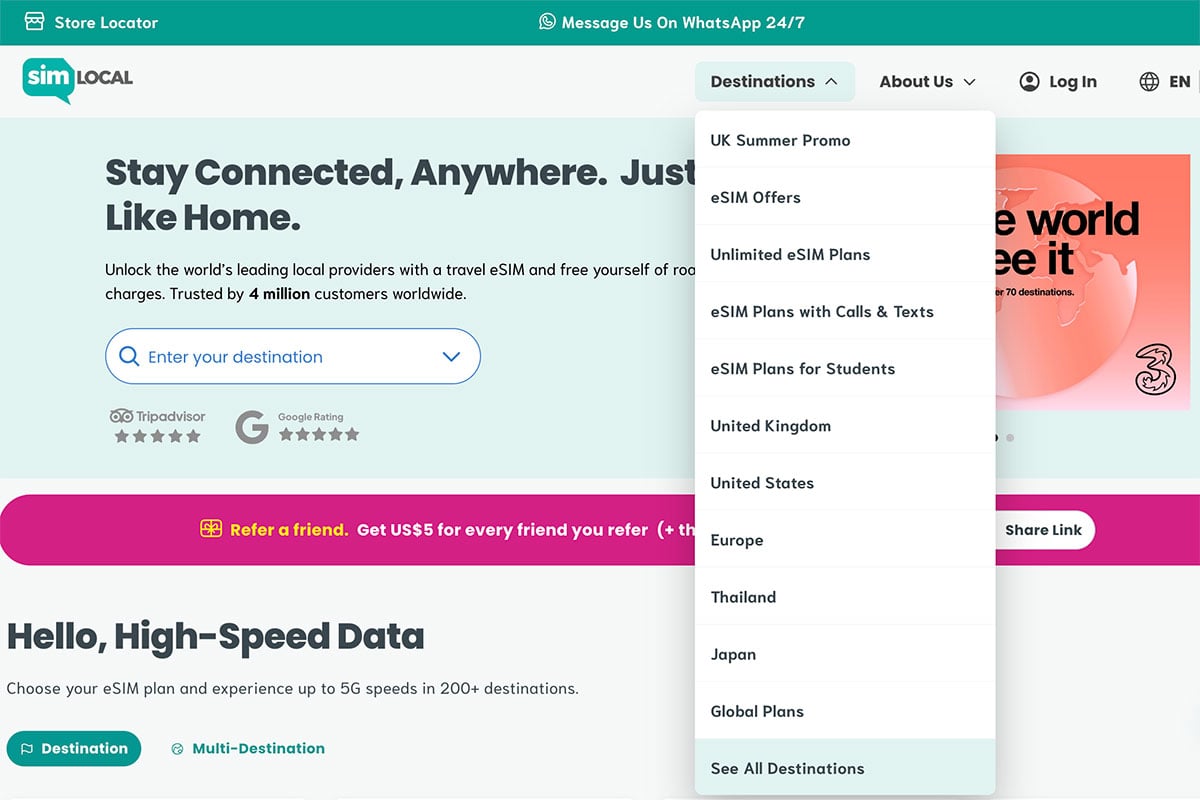
One of the things I really like about Sim Local is how many destinations they cover. There are plans available across 220+ destinations, so you’re not limited to just a handful of popular vacation spots.
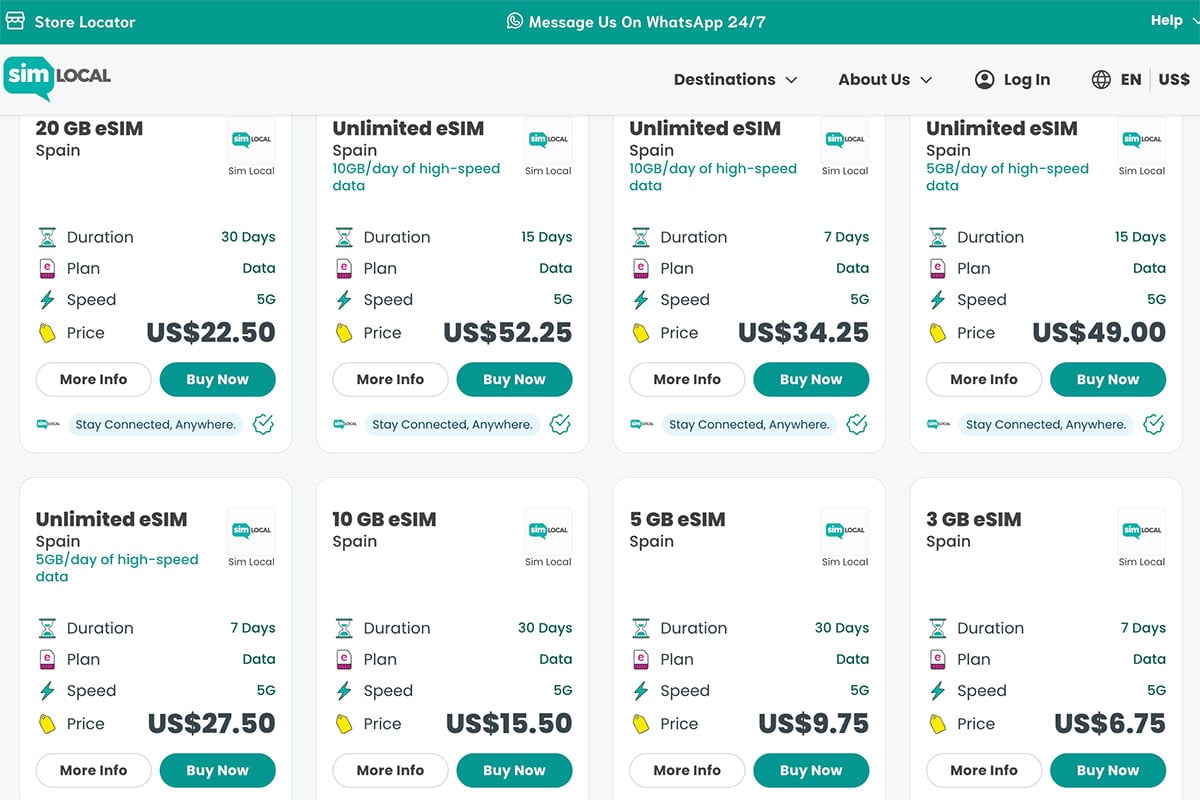
I also like that you can choose between plans based on where you’re going, how much data you expect to use, and how much you want to spend. There are per-GB and unlimited options, with plans ranging from 1GB up to unlimited. You can also choose between local, regional and global plans depending on your trip.
Some travelers barely use their phones beyond Google Maps and messaging, while others are constantly uploading photos, watching videos, using social media or working remotely. Those are very different data needs, so I’d rather have the option to choose an affordable plan that fits my trip than pay for more data than I’ll ever use.
I tested a Sim Local eSIM on my recent trip to Spain, and I was so thankful I had it. My regular phone plan only gives me up to 256 Kbps of international data, which made using Google Maps nearly impossible. And on a road trip around Mallorca, I was constantly using my phone to navigate, look up restaurants, find nearby beaches, and figure out where we were going next.
My partner was relying on the international data included with our regular phone plan, and he basically didn’t use his phone unless we were connected to Wi-Fi. It really drove home for me how much of a difference having a separate eSIM can make when you’re traveling.
With the Sim Local eSIM, I had 4G and 5G coverage everywhere we traveled, so I could use my phone normally without having to think about whether I’d be able to find Wi-Fi.
Another thing I look for when choosing a travel eSIM is how easy it is to actually get it onto my phone. There’s not much point in finding a good plan if the installation process is confusing.
Sim Local offers several ways to install an eSIM, including a one-click option through its app, a QR code, or manual installation. The app also lets you manage your plans and keep an eye on your data usage.
Sim Local has been around for 15 years and has served more than 4 million customers, which makes me feel more secure knowing I’m purchasing from an established company.
There are a lot of different plans, and the right one really depends on how you use your phone when you travel.
Before choosing a plan, you’ll want to answer these questions:
Where am I going?
Sim Local has destination-specific plans as well as options that cover multiple destinations, so start by choosing the country or region where you’ll be traveling.
How long will I be there?
A three-day city break and a month-long trip obviously require different plans. Make sure the validity period covers your entire trip rather than assuming you can simply add more time later.
How much data do I actually use?
This is where things can get a little confusing, so I’ll break it down below.
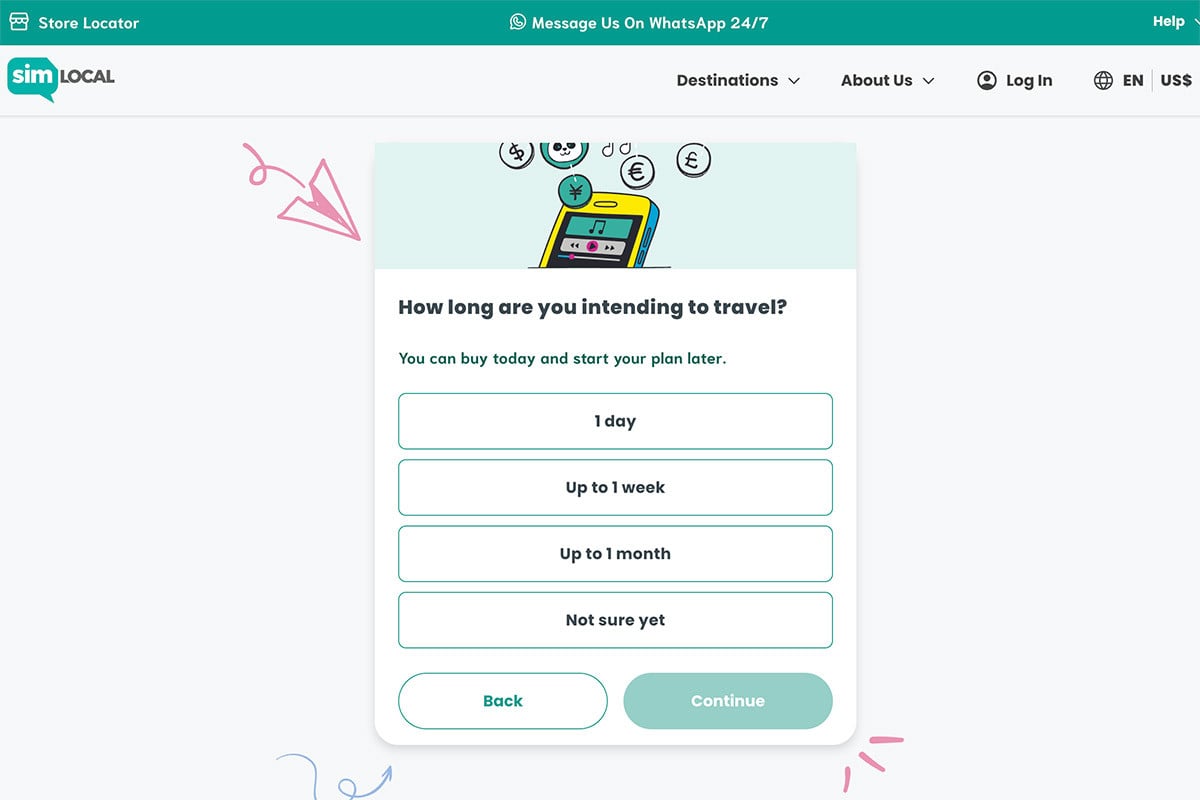
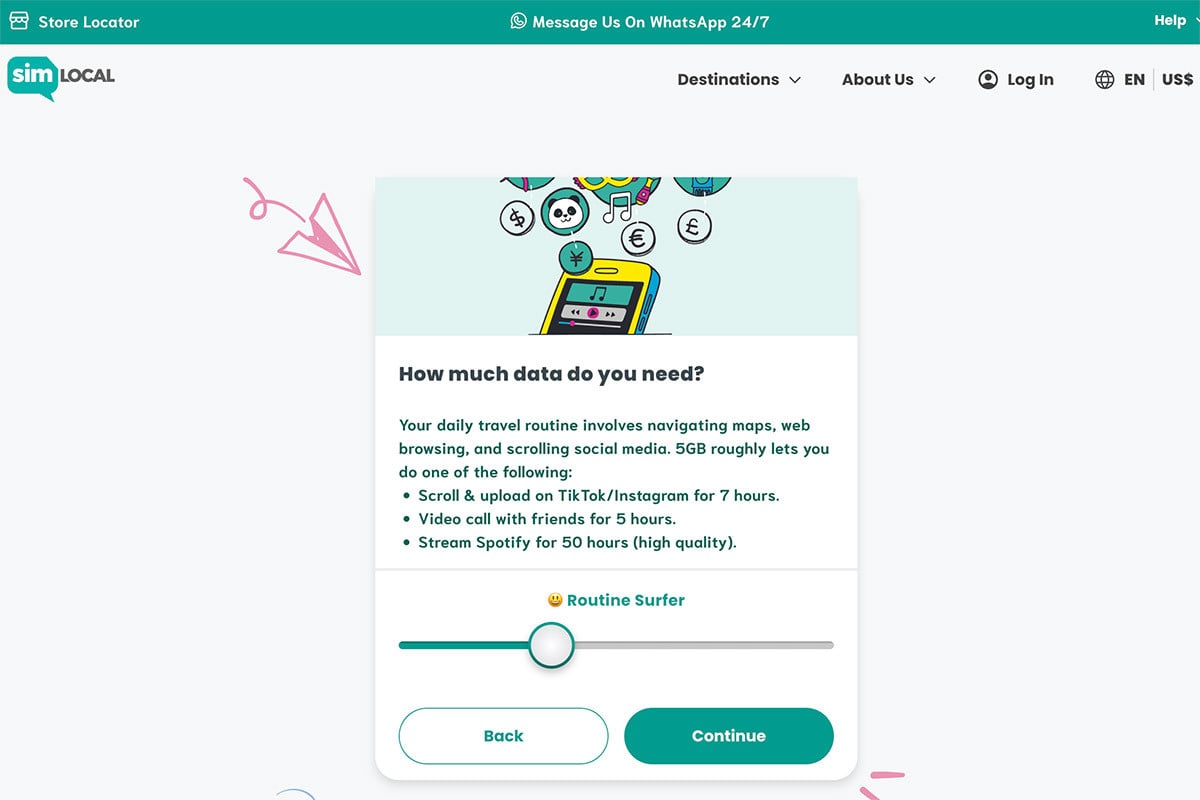
Not sure which plan you need? Sim Local’s Find My Plan tool walks you through four questions and helps narrow down the options based on your trip and data needs.
How Much eSIM Data Do You Need for Travel?
If you mostly use your phone for Google Maps, checking restaurant hours, messaging, email and occasional social media, you probably don’t need a huge data plan.
If you’re uploading a lot of photos and videos, using your phone as a hotspot, working while traveling or streaming video, you’ll go through data much faster.
One easy way to figure this out is to look at your current phone usage before your trip. Most phones will show you how much cellular data you typically use each month.
I’d rather spend a few minutes checking that than blindly choosing the biggest plan available.
And if you’re somewhere in between, remember that you can often top up your data rather than starting over with an entirely new eSIM. Sim Local offers top-up options on eligible plans.
Buying a Sim Local eSIM
Once you know where you’re going and how much data you want, the actual purchase process is pretty straightforward.
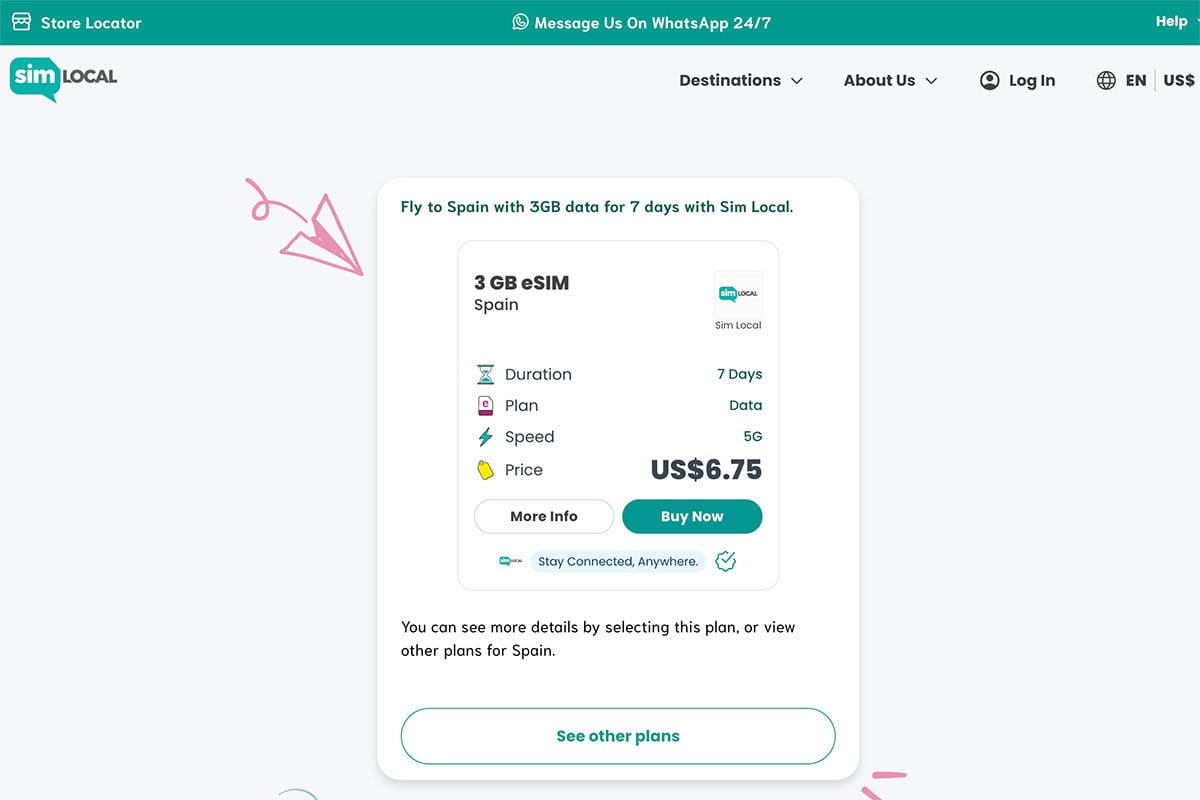
You choose your destination, select a plan and complete the purchase online. Sim Local then provides the instructions for installing your eSIM through the app or by email.
This is one of the reasons I prefer the idea of getting an eSIM before a trip rather than trying to figure out a local SIM card after landing.
With an eSIM, you can get the setup out of the way ahead of time.
There are a couple of things you do want to check before buying, though. Your phone needs to support eSIMs and it needs to be carrier unlocked. You’ll also want a reliable Wi-Fi connection when you install the plan.
Installing My Sim Local eSIM
This was the part I was most interested in trying because, if you’ve never installed an eSIM before, this is probably where you’re wondering how complicated it’s going to be.
Sim Local’s easiest option is its one-click installation through the app on compatible devices. After purchasing your plan, you can sign into the app using the same email address you used for your purchase, find your eSIM under your plans, and select the option to install it.
If your device or plan doesn’t support one-click installation, you can also install it using a QR code or manually enter the activation details.
Once the eSIM is installed, you’ll see it listed alongside your regular SIM in your phone’s cellular settings.
That’s actually one of the things I like about using an eSIM. You don’t have to physically remove your normal SIM card and worry about losing that tiny little piece of plastic somewhere in your suitcase.
Installing the eSIM is only part of the setup. You also need to make sure your phone knows which line you want to use for mobile data when you arrive.
On an iPhone, that means going into your cellular settings and selecting the new travel plan under Mobile Data. Sim Local recommends turning off Data Switching and enabling Data Roaming for the travel eSIM. If your plan includes calls and texts, you can also select the travel plan as your default voice line.
The nice thing is that you can do all of this before you actually need the service.
Depending on the plan, activation generally happens when you arrive at your destination, so you don’t need to start using your travel data while you’re still at home. Sim Local recommends installing the eSIM shortly before your trip and following the activation instructions for your particular plan.
A Few Things to Know Before Buying a Travel eSIM
There are a few things I would check before purchasing any travel eSIM, including Sim Local.
Make sure your phone is unlocked.
If your phone is locked to a specific carrier, you may not be able to use another provider’s eSIM.
Check that your phone supports eSIM.
Most newer phones do, but it’s worth checking your specific model before buying.
Look at exactly what the plan includes.
Not every eSIM is the same. Some are data-only, while others include calls and texts. Some plans allow hotspot use, and the amount of data and validity period can vary.
Is Sim Local a Good eSIM for Travel?
For me, the biggest benefit of a travel eSIM is flexibility.
If your current phone plan does not include international data, I highly recommend buying an eSIM.
Sim Local has plans available in 220+ destinations, with different amounts of data and price points depending on what you need. It’s one of the best options I’ve found for affordable and reliable international data.
I also appreciated how easy Sim Local was to set up. Having a straightforward buying and installation process was a big plus for me.
If you’re considering an eSIM for an upcoming trip, you can take a look at Sim Local’s plans here. And if you decide to give it a try, use code ORDINARYTRAVEL for a 5% discount off your eSIM plan.
An eSIM is a digital SIM card that’s built into your phone, so you don’t need to insert a physical SIM card to connect to a mobile network.
Is an eSIM better than a physical SIM card?
For travel, I find an eSIM more convenient because you can purchase and install it before you leave home without having to find a local SIM card after you arrive. You also don’t have to remove your regular SIM card.
Can I use an eSIM and my regular SIM at the same time?
On compatible phones, yes. You can have your regular SIM and a travel eSIM installed at the same time and choose which line you want to use for mobile data.
Does my phone need to be unlocked to use an eSIM?
Yes. Your phone needs to be carrier unlocked in order to use an eSIM from another provider.
Can I use an eSIM for multiple countries?
Yes, depending on the plan. Some eSIMs are designed for a single country, while others cover multiple countries within a region or even multiple regions around the world. If you’re visiting more than one country, check the coverage before purchasing.
I’m a huge fan of autumn. I love the changing leaves, the slight chill in the air, and long dog walks with a hot coffee in hand. But one thing I hate? Muddy shoes cluttering my hallway. That’s why I’ve been on the hunt for a shoe rack to get ahead of the mess, and the new Lakeland Multi Shoe Rack (£29.99 at Lakeland) fits the bill perfectly.
I’m currently on a mission to follow in the footsteps of people with consistently tidy hallways, and I’ve known my entryway has been missing some proper shoe storage for a while now. My husband and I have got into the bad habit of leaving our wet, muddy shoes on the doormat inside the house, and that makes our tiny space look even more cluttered.
But without a lot of space – or budget – to buy a huge shoe cabinet, I’ve had to look for a more effective shoe storage idea for small spaces, and this new Lakeland drop is both space-savvy and affordable.
Lakeland
Multi Shoe Rack
The foldable design means you can configure this as a 2-tier or 4-tier shoe rack, which is pretty impressive!
When I spotted this shoe rack, I knew it wouldn’t be a conscious design addition to my hallway. After all, it’s not the most aesthetic shoe rack I’ve ever come across – but pretty shoe storage often comes at a much heftier price.
But this Lakeland alternative is practical and affordable, and sometimes that’s all you need to transform your hallway from a cluttered, muddy mess into something to be proud of. Especially since this £30 solution fits 8 to twelve pairs of shoes and can be configured to suit your space.
(Image credit: Future PLC/Colin Poole)
Yes, with a clever design feature that I’ve never seen before, this shoe rack can be assembled in two different ways. You can use it in a longer, wider two-tier formation, or fold it into a taller, narrower 4-tier formation.
This means that you can fit it around the other items already taking up space in your hallway, from coat racks and console tables to more permanent features like radiators.
For example, I know the 4-tier formation would be better in my house because the radiator limits the available wall space, and I know from speaking to experts that utilising vertical space is key in smaller spaces.
(Image credit: Future PLC)
But having the option to switch it up also lets you use this shoe rack in other rooms and areas of your home. You could add another to your under-the-stairs cupboard, or opt for the lower-slung configuration at the bottom of your wardrobe to organise the shoes you wear regularly but don’t use enough to keep downstairs by the door.
With muddy season already underway, the wipe-clean material also means that you can simply wipe away the grime your shoes leave behind, keeping your hallway spotless.
And for just £29.99, how can you argue with that?
Shop budget shoe racks
Dunelm
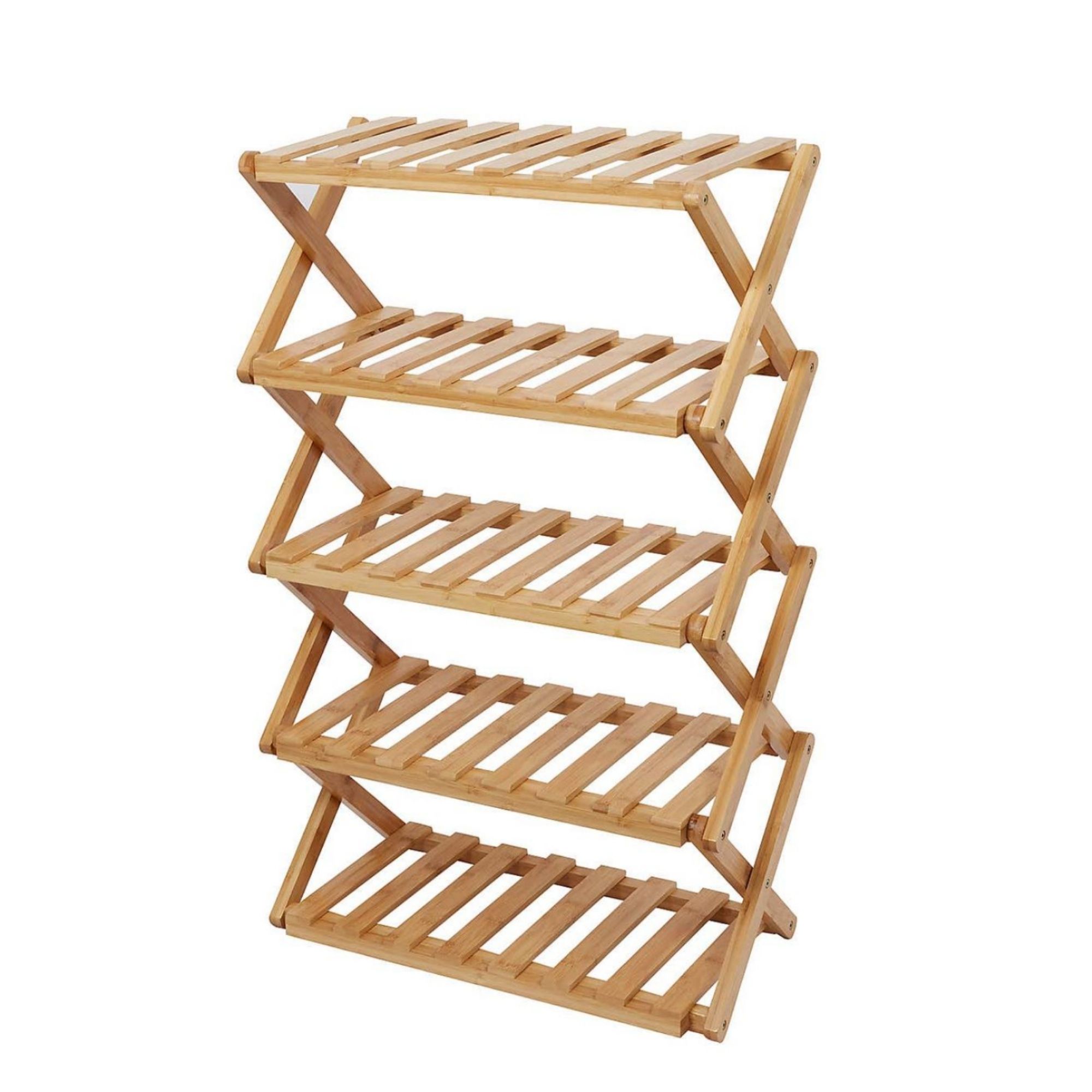
Bamboo Folding Shoe Rack
This shoe rack doesn’t fold the same way, but it’s still an ideal space-saver, since you can fold it down when you’re not using it. When you do need it, there are 5 shelves to make use of.
Altdnmaf
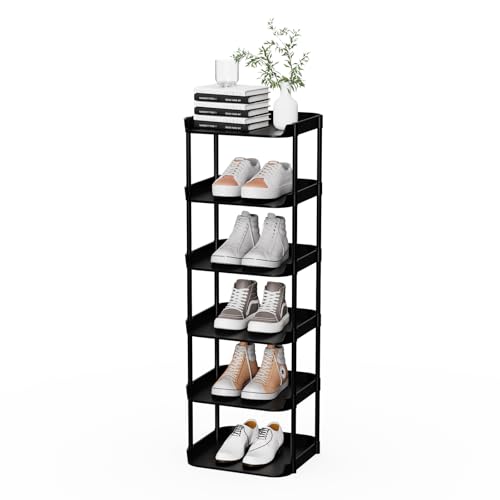
6 Tier Narrow Shoe Storage Rack
This budget-friendly shoe rack will fit in the corner of your hallway and offer storage for your most-used shoes. You can even use the top for flowers, candles or a tray to keep your keys safe.
Habitat
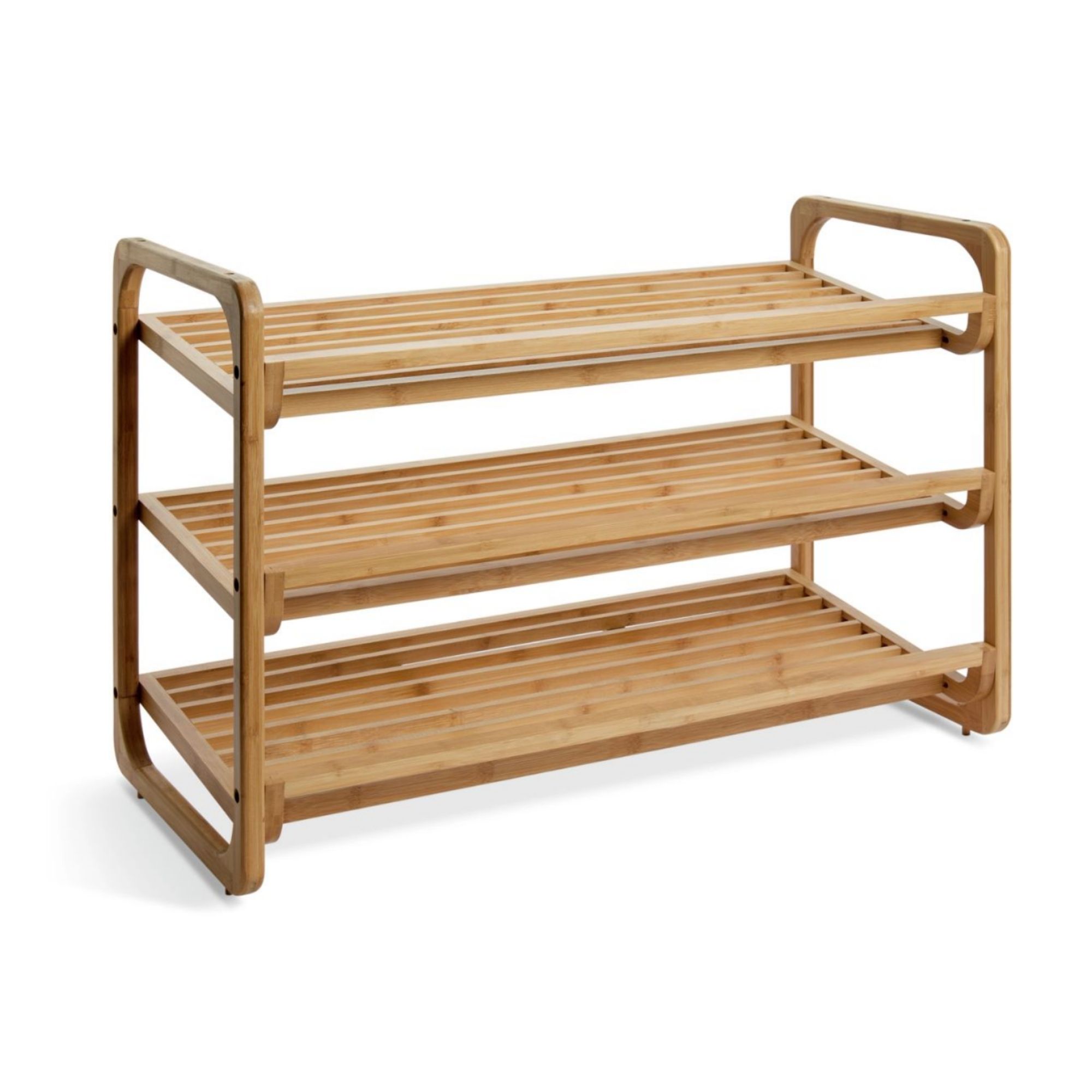
Belem 3 Shelf Shoe Storage Rack – Natural
This shoe rack is slightly pricier, but still very affordable – and it’ll make much more of a statement in your hallway thanks to the natural bamboo shelves.
I’m definitely snapping up Lakeland’s new £30 shoe rack to get ahead of the mess this autumn.
Interior design experts are advocating for us to apply the Japanese practice of ikigai to homes to ensure our spaces are places that add small pleasures to our lives.
Ikigai is more than just a home decor trend. With ‘Iki’ translating to ‘life’ and ‘Gai’ meaning ‘worth’ or ‘value’, it literally means ‘that which makes life worth living.’ And interior experts say that this principle can be applied to how we spend time at home and to our home decor.
‘The concept dates back to the Heian period, between 794 and 1185, when it appeared in poetry and court diaries as a way to describe moments of deep personal satisfaction. Rather than a single overarching goal, ikigai is really about the daily realisation that life is worth living in the present moment,’ explains Gini Lin, founder of Airy Fragrances.
‘It is found in small domestic pleasures: the first sip of warm tea in the morning, the way afternoon sunlight hits a wooden floor, or the satisfying feeling of preparing a simple meal. It is less about what you achieve and more about how present you are in the small rituals that make up your day.’
How to apply ikigai to our homes
Considering ikigai centres on finding meaning in everyday life, it is perhaps natural that this principle lends itself well to our home lives. It’s a useful practice to follow if you’re looking for ways to make your home feel happier.
(Image credit: Future PLC/ Paul Raeside)
‘The home is where ikigai is most naturally expressed, and most consistently overlooked. We spend enormous energy designing homes that look considered, but far less on making them feel considered. The two are not the same,’ says Gini.
‘It starts with one question about every object and every ritual in your space: does this add meaning to my day? It doesn’t photograph well, nor is it on trend, but it gives me something when I am actually living inside it. A chair placed to catch morning light. A surface cleared of everything except what belongs to one activity. A scent so tied to a particular room that walking into it feels like arriving somewhere.
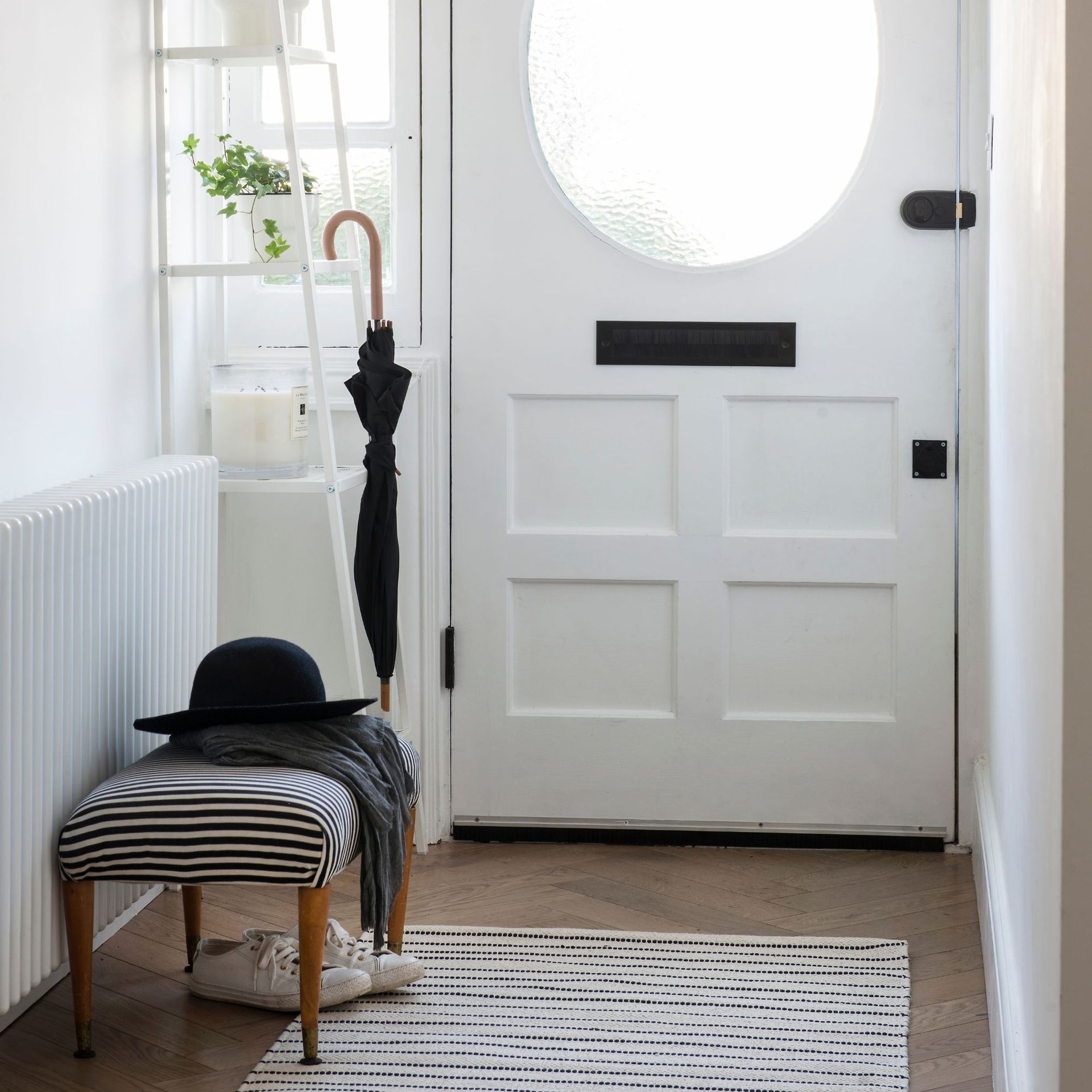
‘In Japan, this way of thinking about domestic space has been practised for centuries, built into the genkan entrance that separates the noise of the outside world from the calm of home, the single seasonal flower changed with the months, the ritual of removing shoes before crossing the threshold. The home is not a backdrop to life. It is where life is actually lived.’
What does ikigai look like in practice?
In practice, ikigai can be as simple as appreciating your favourite candle scent or reed diffuser in your bedroom, opting for specific materials that feel good on your skin, such as linen bedding.
‘For me, it comes back to creating spaces that feel comfortable, welcoming and personal. I like rooms to have a sense of character rather than feeling too perfect, and I think surrounding yourself with colours, patterns and textures that you enjoy can make a real difference to how you feel at home,’ says Debbie Leigh, design manager at ILIV.
‘I also think there is something to be said for creating small spaces or moments that encourage you to slow down, whether that is sitting down with a cup of coffee, reading for a while or simply enjoying the natural light coming into a room.’
Gini’s approach would be to start with the five senses, which ensures you don’t only address things in your home which you can physically see.
(Image credit: Future PLC/Davide Lovatti)
‘Scent is one of the most direct routes to the limbic system, the part of the brain that processes memory and emotion. It arrives before rational thought, which means it shapes how a space feels before you have consciously registered anything about it. A room with its own scent has its own identity. It becomes somewhere specific, somewhere that belongs to you. That is a form of ikigai built into the architecture of a space,’ she says.
‘I would also introduce objects that invite you to slow down: a hand-thrown ceramic cup you love the feeling of holding, a decorative glass piece that catches the light in a particular way, a reed diffuser that makes you feel good the moment you walk in. These sensory anchors create a pause between the pace of the outside world and the pace of being home.
‘Personally I am a minimalist, and I think that instinct is deeply connected to ikigai. When a home is full of things that have stopped earning their place, the mind has nowhere to settle. Removing the unnecessary is not about aesthetics. It is about clarity.
‘A clear surface, a corner left empty, soft warm light rather than harsh overhead brightness: these create the conditions for the atmosphere of a room to actually be felt. Japanese spatial philosophy calls this yutori, breathing room. You cannot notice the small meaningful moments of daily life if there is too much competing for your attention. Yutori is what makes noticing possible.’
Is this a good philosophy to live by?
For our experts, ikigai is a good practice to live by simply because it doesn’t ask too much of us. All we must do is appreciate that the simple things make life worth living.
(Image credit: Future PLC/James Merrell)
‘I like the idea that there doesn’t have to be one big source of happiness or purpose. It can be found in the small things that make everyday life feel good. The same can be true of our homes. They don’t need to be perfect or follow every new trend. They should make sense for the people who live in them and support the things that bring them pleasure, comfort and connection,’ says Debbie.
And Gini agrees, stating: ‘For the home specifically, this is a profound reframe. The home stops being a place where you recover from your life so you can go back and live it again tomorrow. It becomes the place where your life is actually happening. Every small ritual, every considered object, every scent that makes a room feel like yours: these are not decorations. They are the thing itself.’
How I practice ikigai
M&S
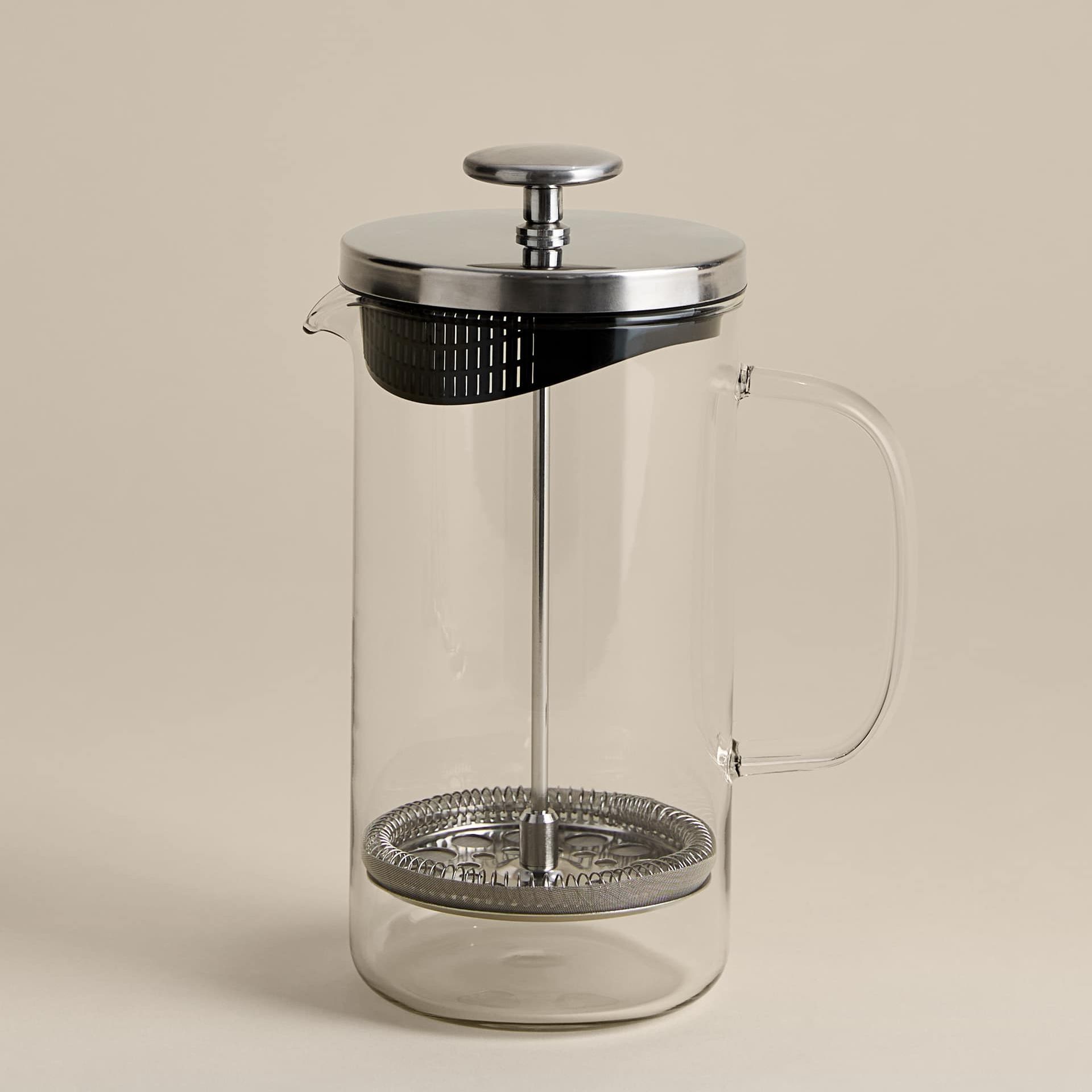
Glass 8 Cup Cafetiere
There’s nothing that makes me happy than a quality black coffee, sipped in bed with my book on a Sunday morning. It’s this weekend ritual that always makes me appreciative of my life.
Dunelm
Supersize Bubble Family Fleece Throw 240cm X 280cm
Equally, there’s nothing better than snuggling down under a blanket when the weather is vile outdoors. I can vouch that this blanket is super soft and cosy, and right now £2 of proceeds go to Age UK.
The White Company
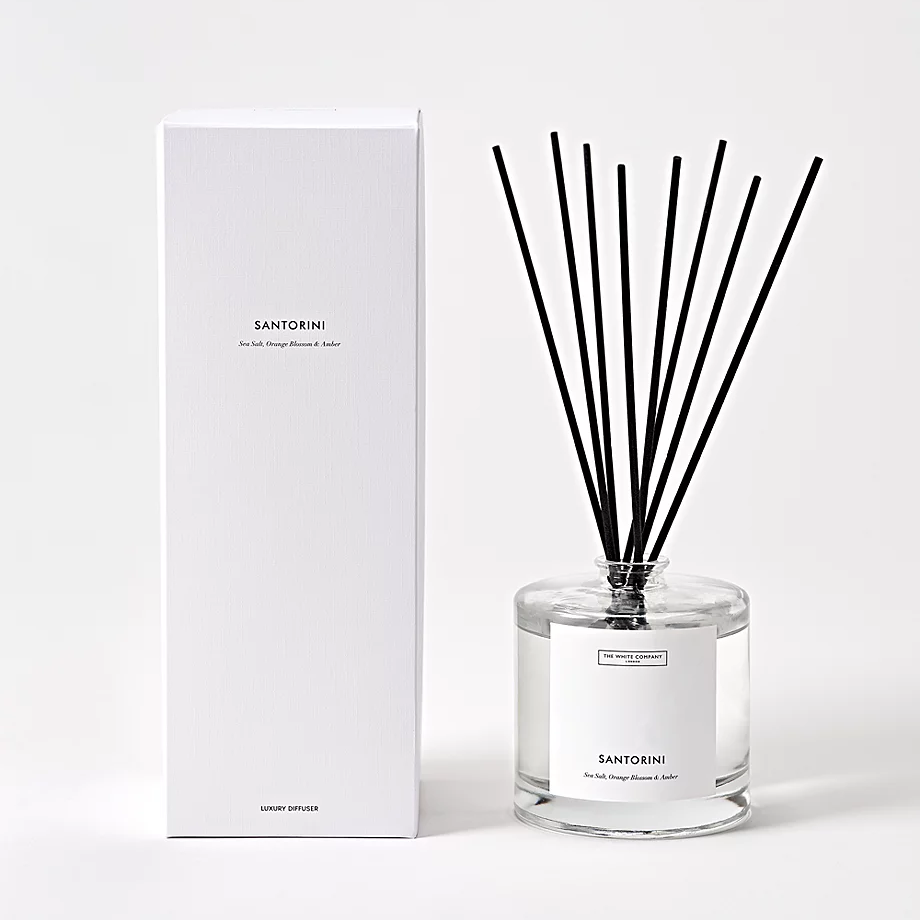
Santorini Luxury Diffuser
To me, this fragrance smells like home. I’ve used it to scentscape my flat more than a year now, and I can never get bored of it’s fresh, uplifting fragrance.