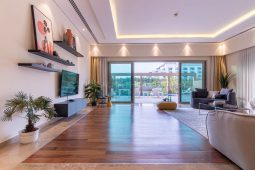
Sheraton Amman Al Nabil Hotel has been voted as Jordan’s Best MICE Hotel 2026 at the prestigious World MICE Awards, recognizing its commitment to excellence in meetings, incentives, conferences, and exhibitions, and its role in supporting Jordan’s growing business events sector.
Quinta do Lago has once again been named Portugal’s Leading Resort at the World Travel Awards 2026, marking the second consecutive year that the Algarve destination has received the prestigious accolade. The recognition further cements the resort’s position at the forefront of Portugal’s luxury travel offering and reinforces its status as one of Europe’s leading lifestyle destinations.
Bury St Edmunds is a charming town in the heart of Suffolk. It has picturesque medieval houses, a glorious botanical garden, a magnificent cathedral, the ruins of one of the most important abbeys in Europe and dozens of independent shops and appealing places to eat and drink.
But it has a very dark side: the shameful distinction of holding the biggest trial of witches in England. It took place in August 1645 when over a hundred were brought on carts from the surrounding areas to the town. Eighteen were found guilty and hanged. They, like others before and after them, were the victims of the maniacal Matthew Hopkins, the self-styled Witchfinder General, who himself was just one player in the frenzy which swept across Europe and the American colonies in the late 16th and 17th centuries.
Women, and a few men, could be accused of anything from putting toads in a baby’s bed or infesting someone with lice to causing buildings to collapse and people and animals to sicken and die. For many accusers it was a way of settling scores or indulging a grievance.
The story is told in a fascinating new exhibition, Crime and Superstition, which opens appropriately on Halloween at Moyse’s Hall Museum. Victims whose names are known will be honoured on a special memorial, but their fate is also put in the wider context of the beliefs and practices of the times
Mummified cats
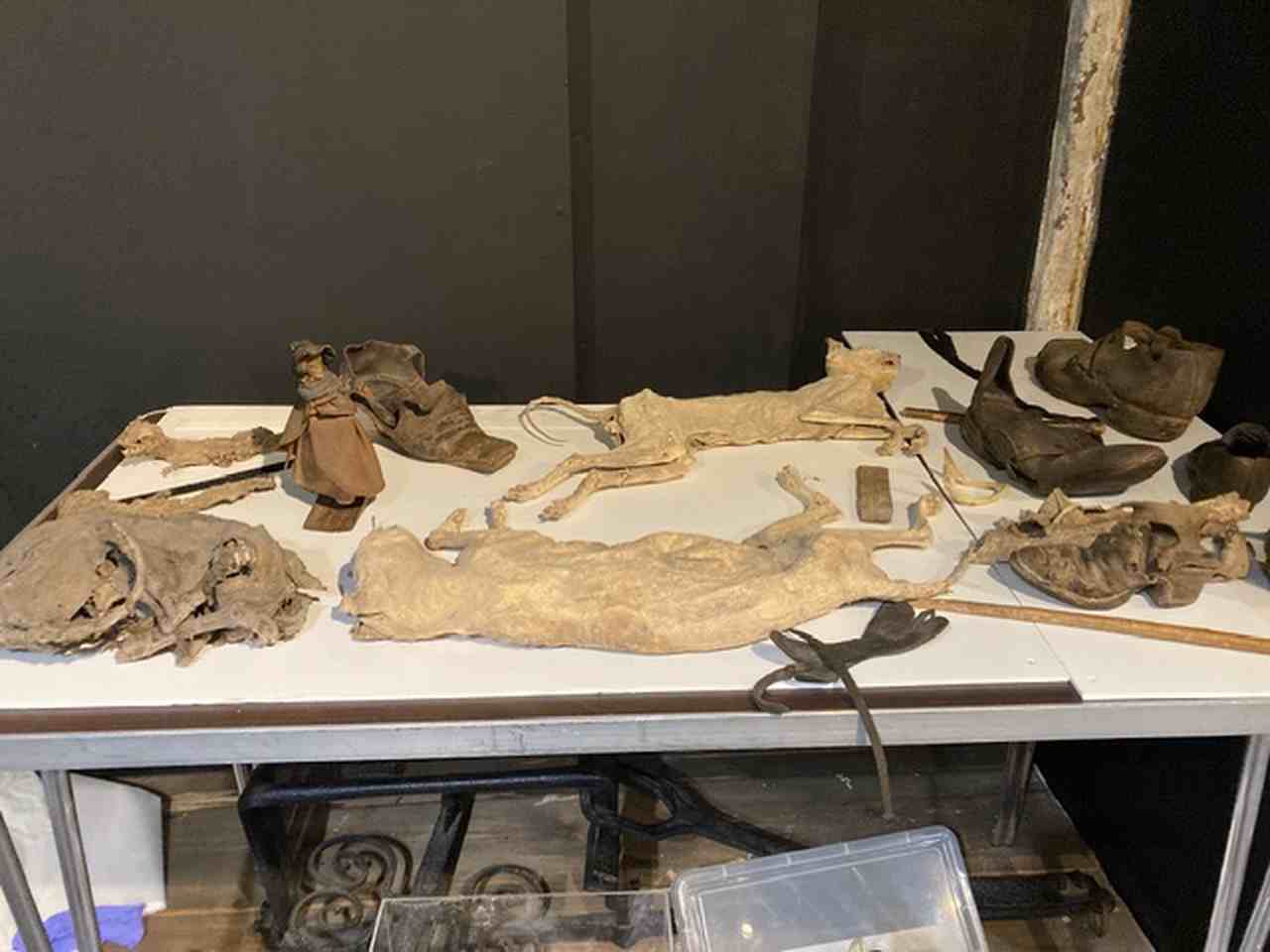
So, for example, there are two mummified cats and two kittens and two pairs of shoes, a child’s and an adult’s which as ‘ritual deposits’ would have been hidden in a house to draw evil spirits away from the inhabitants. Similarly, ‘witch bottles’ filled with urine and pins would be there to draw in any witch’s spells and then skewer them on the pins. There is also a ‘poppet’ on display, a doll which could be used to bless or curse and a rare copy of A Tryal of Witches an account of the proceedings against Amy Denny and Rose Cullender, which was later to influence the notorious witches’ trial in Salem, Massachusetts, because it allowed children’s hearsay and ‘spectral evidence’ of dreams and visions.
Among the other artefacts not connected with witchcraft are manacles, a man trap, a trip wire gun and a gibbet cage in which were displayed the bodies of the worst criminals. One display is devoted to William Corder, who shot and stabbed his girlfriend Maria Marten in the scandalous Red Barn Murder. It includes his death mask, scalp and a book bound in his skin. He was hanged for his crime in front of hundreds of people many of whom then paid a shilling an inch for the rope.
Ghostly and Macabre Walk
The gruesome and chilling side of Bury St Edmunds, however, is not confined to the museum as I discovered later on the Ghostly and Macabre Walk when costumed guides led us past the site of sightings and other paranormal phenomena and regaled us with tales of terror.
Priory Hotel,
One of the town’s most famous spectres is the Grey Lady who has been seen in the cathedral churchyard, the abbey ruins and the Priory hotel built on the site of an ancient friary (where I spent a comfortable but untroubled night). Other ghosts include the Brown Monk, a Crimea nurse and her soldier lover (her father disapproved and shot him) and a little boy in the upstairs room of the Nutshell pub. In a more modern manifestation, staff at the Body Shop have reported smelling tobacco smoke, kettles boiling without being switched on, and merchandise scattered around.
More tangible reminders of death and suffering included the monument to the 17 Protestant martyrs burned at the stake in the reign of Mary Tudor and the Charnel House where bones were stored when graveyards became too full. One interesting snippet I learned was the fact that the word bonfire stems from bonefire, which is what they did when there were too many even for the charnel house.
Earlier I’d enjoyed the town’s daytime attractions on a guided walking tour which began with the story of St Edmund, England’s first patron saint. Crowned King of the East Angles in 855, in 869 he assembled an army to march on Viking invaders. Defeated in battle, he fled in an attempt to draw the enemy away from the survivors, but the Vikings caught him, tied him to a tree, shot him full of arrows and finally beheaded him for refusing to renounce his Christianity. His followers found the head between the paws of a great grey wolf; miraculously it rejoined the body.
In 1020 King Cnut or Canute, remorseful about his ancestors’ crime, built a shrine to St Edmund. Over the next 200 years, the Benedictine abbey which housed it grew to become one of the biggest and wealthiest in Europe – it owned a third of Suffolk – and one of the most important places of pilgrimage in Christendom.
Our guide Cathy asks us to imagine the pilgrims who arrived here, having walked a hundred miles or more, maybe on their hands and knees for the last 200 yards.
“As soon as they arrived they would be relieved of their money. Inside the church they would see huge embroideries of Biblical scenes, the magnificent fan vaulted ceiling and the stained glass. The tomb of St Edmund would have been a huge gold coffin on a plinth studded with jewels and lit by candlelight. They would fall to their knees and say their prayers. They would then be shown out again and have to walk back home with no money.”
Abbey ruins
Today only the ruins remain, but even so they evoke the staggering scale of the place and its power. Seven kings visited it during its years of eminence until the Dissolution of the Monasteries by Henry VIII put an end to it all. One old wall bears a plaque recounting an historic moment when 25 barons, incensed by the profligacy and greed of King John, resolved to curb his powers, a decision which led to the Magna Carta. Their leader was Baron Bigod after whom the award-winning brie style local cheese is named.
The tour also passes the site of a small peasants’ revolt when rebels rolled a burning cart into the abbey gate, Tudor houses, the Georgian Atheneum where Oscar Wilde and Charles Dickens appeared (the nearby Angel hotel is mentioned in Pickwick Papers), the massive Corn Exchange which now houses what claims to be the poshest Wetherspoons and the 800 year-old Guildhall which has played a variety of roles including being the hq of the RAF Royal Observer Corps Operation in WWII whose ‘spotters’ dotted around the surrounding areas could identify 200 different aircraft by sight and sound to tell whether they were ours or the enemy’s.
St Edmundsbury Cathedral
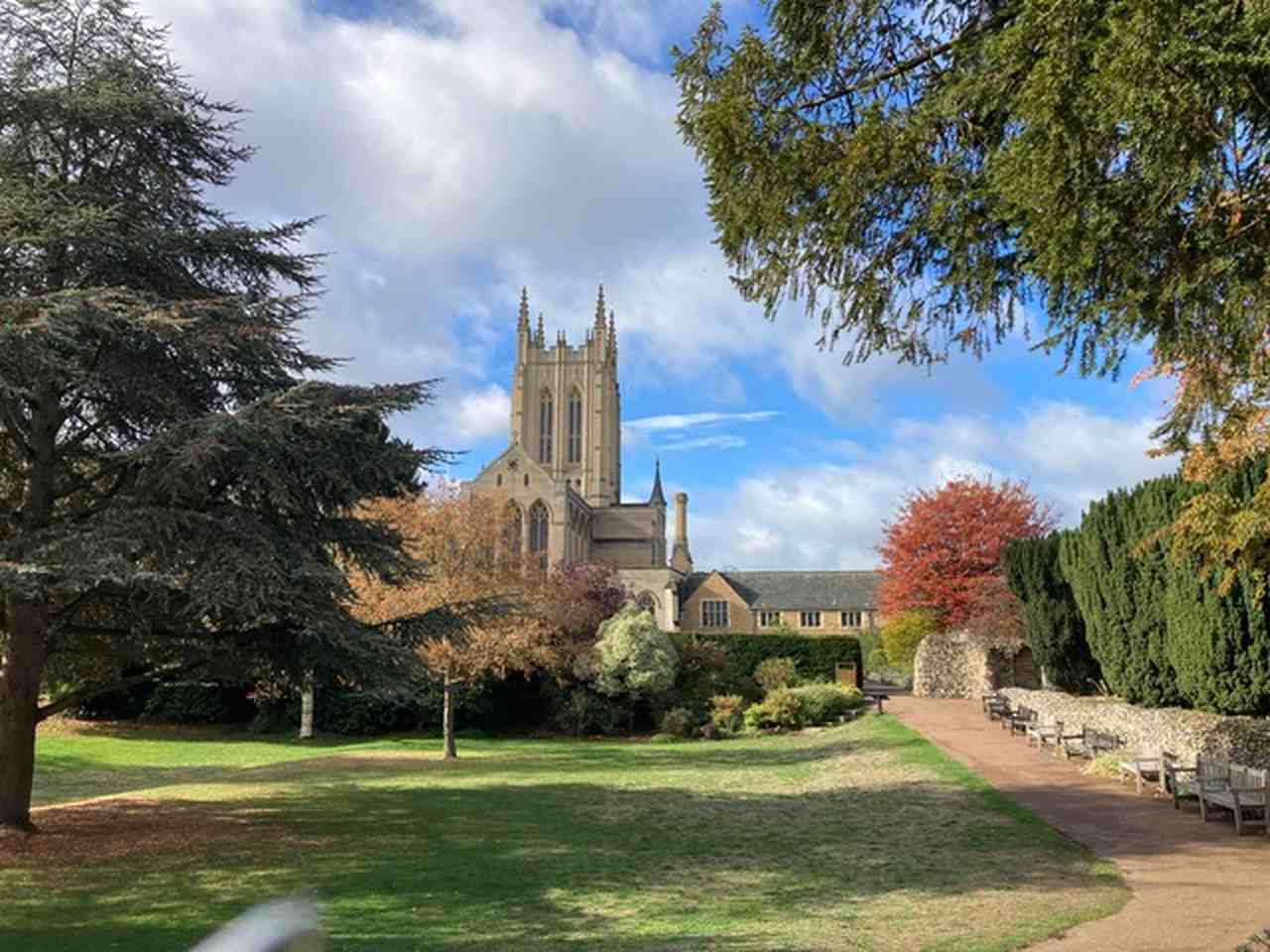
After the tour I go inside the St Edmundsbury Cathedral, whose Millenium Tower is so named because it was only begun in 2000, to look not just at its historic splendours but at a recently made scale model of 200,000 pieces of Lego. Not far away is the equally interesting St. Mary’s Church which houses the remains of Mary Rose, the favourite sister of Henry VIII (he named his ill-fated warship after her) and once Queen of France until the death of her husband Louis XII after which she became Duchess of Suffolk. Queen Victoria thought her tomb too modest for a royal and commissioned a new stained glass window in her honour. Not far away is a rare example of a ‘cadaver tomb’ in that the figure on its top shows the occupant’s body in a state of decomposition.
It was, perhaps, time for a drink at the smallest pub in England, the wonderful 15ft by 7ft The Nutshell with its ceiling covered in banknotes from around the world and its walls covered with odd memorabilia. There is also a mummified cat hanging above the bar in a glass case. Legend has it that ill luck will befall anyone who touches or moves it. Made cautious by all the spooky goings on in Bury St Edmunds, I decide the only glass I’m going to touch is the one in my hand.
While Bhutan, in the Eastern Himalayas, is known for its valleys, Paro is one of the most accessible; it’s not too far from Paro International Airport, around an hours’ drive away. The drive passes through forested mountains to Six Senses Paro, set at an elevation of 9,500 feet (2.7 kilometers) in the Paro Valley, amid peaceful, lush surroundings with sweeping views over the mountainscape. Personally, I deeply love nature and enjoyed my end-to-end experience at Six Senses Paro.
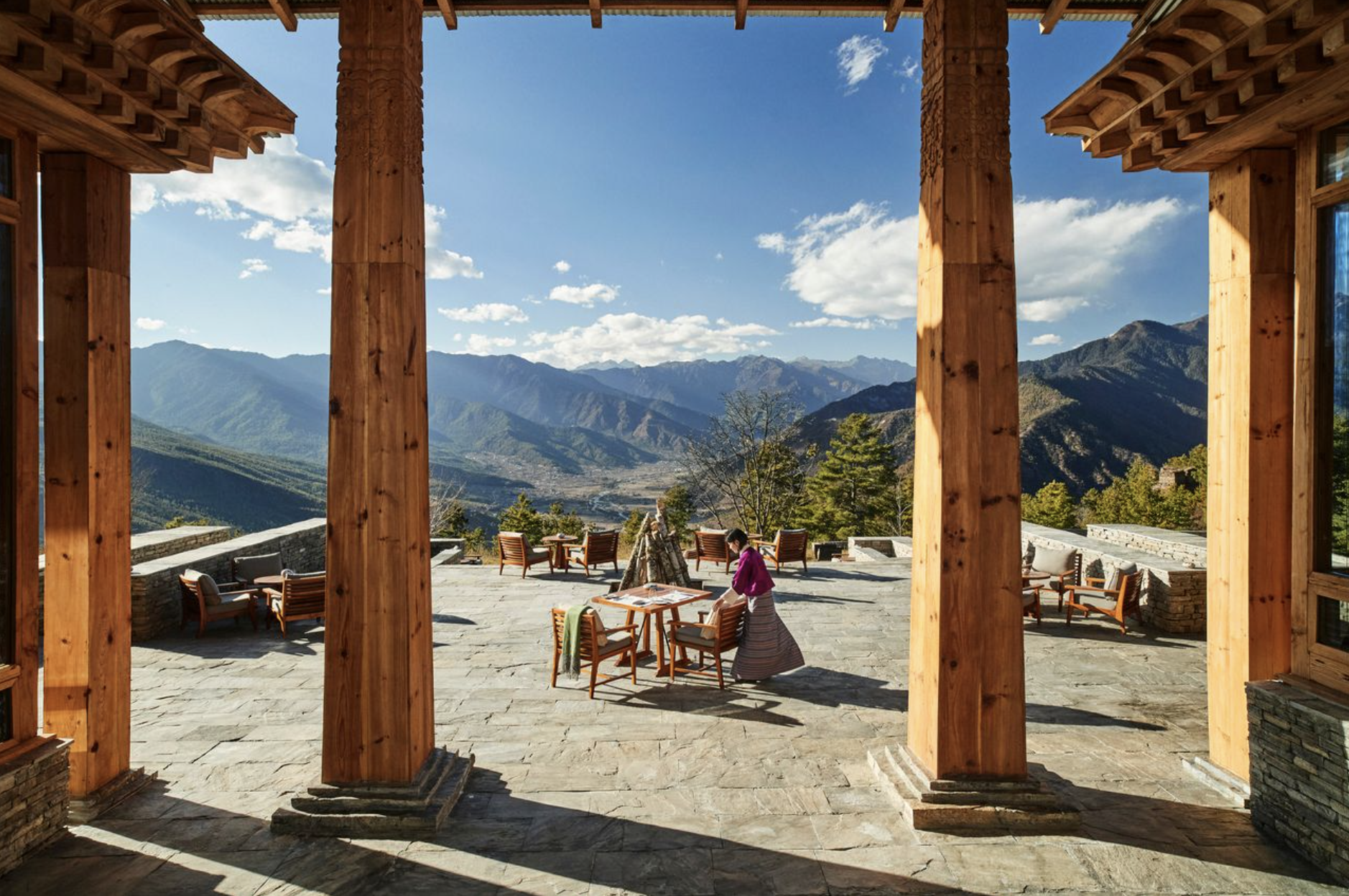
Six Senses Paro is perched on top of a hill, built on stone ruins and known as Stone Ruins. The lobby is expansive, and the welcome ritual involves picking a tea and having it fresh.
Six Senses Paro lobby
Bhutan as a destination is a place where you leave expectations behind. Bhutan is the happy country where Gross National Happiness takes centre stage. It’s not about people but connection; not simply food but health and mental wellbeing is prioritised. Every conversation and moment in this country feels slower, simpler and peaceful.
And that is how it is at Six Senses Paro.
Who for
Couples and honeymooners would love the serenity and the beauty, and families with children and extended families can relax. It is suitable for everyone looking for peace of mind, wellness rituals and Bhutanese food. However, the property is mostly frequented by wellness connoisseurs who prefer to sleep on time and wake up to some wellness rituals.
Accommodation
Six Senses Paro bedroom
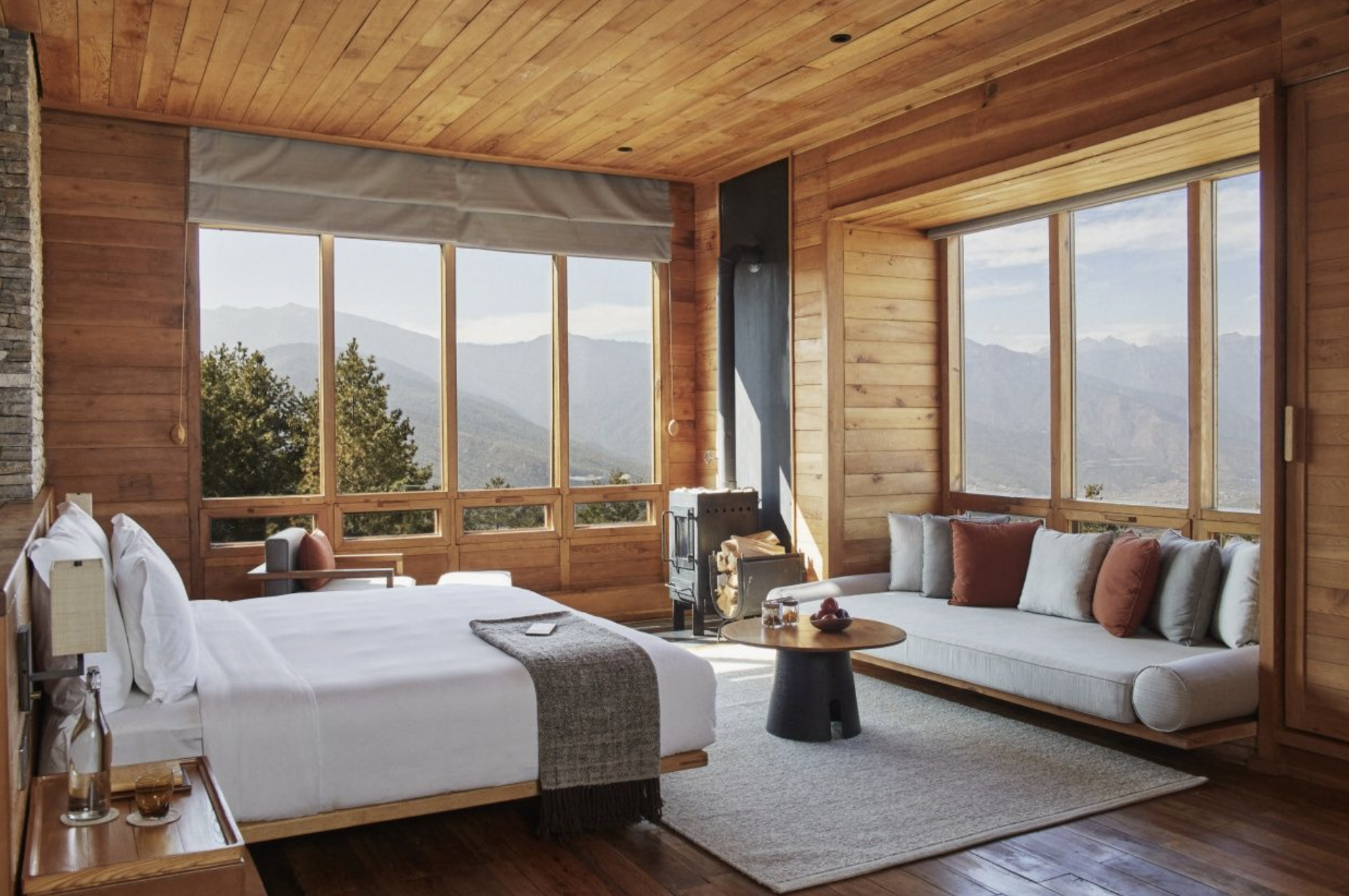
There are 82 spacious villas and suites, most with long windows and spectacular views over the Thimphu Valley. The decor of the rooms carries the essence of the hills with rustic tones of brown and white. The massive king-sized bed is inviting, and best of all, you wake up to the view of the hills of the Paro Valley. The room also has a ledge on the side to sit on, perhaps inviting you to read a book. All the rooms have a luxury bathtub with complimentary natural bath salts.
Food and Drink
Six Senses restaurant
Meals at Jangkho restaurant adjoining the lobby. The design is inspired by the stone dzongs (or fortresses) seen all over Bhutan, with brick walls, wooden floors and ceilings, and show-stealing views out over the Paro Valley. Jangkho is an all-day restaurant serving bespoke meals with many ingredients grown in their own gardens. Ema Datshi and Shamu Datshi are cheese-heavy local Bhutanese dishes which tourists eat pretty much every day. Among other niche experiences, Six Senses Paro highlights a tea ceremony with unique blends of tea.
Facilities
Paro Bhutan
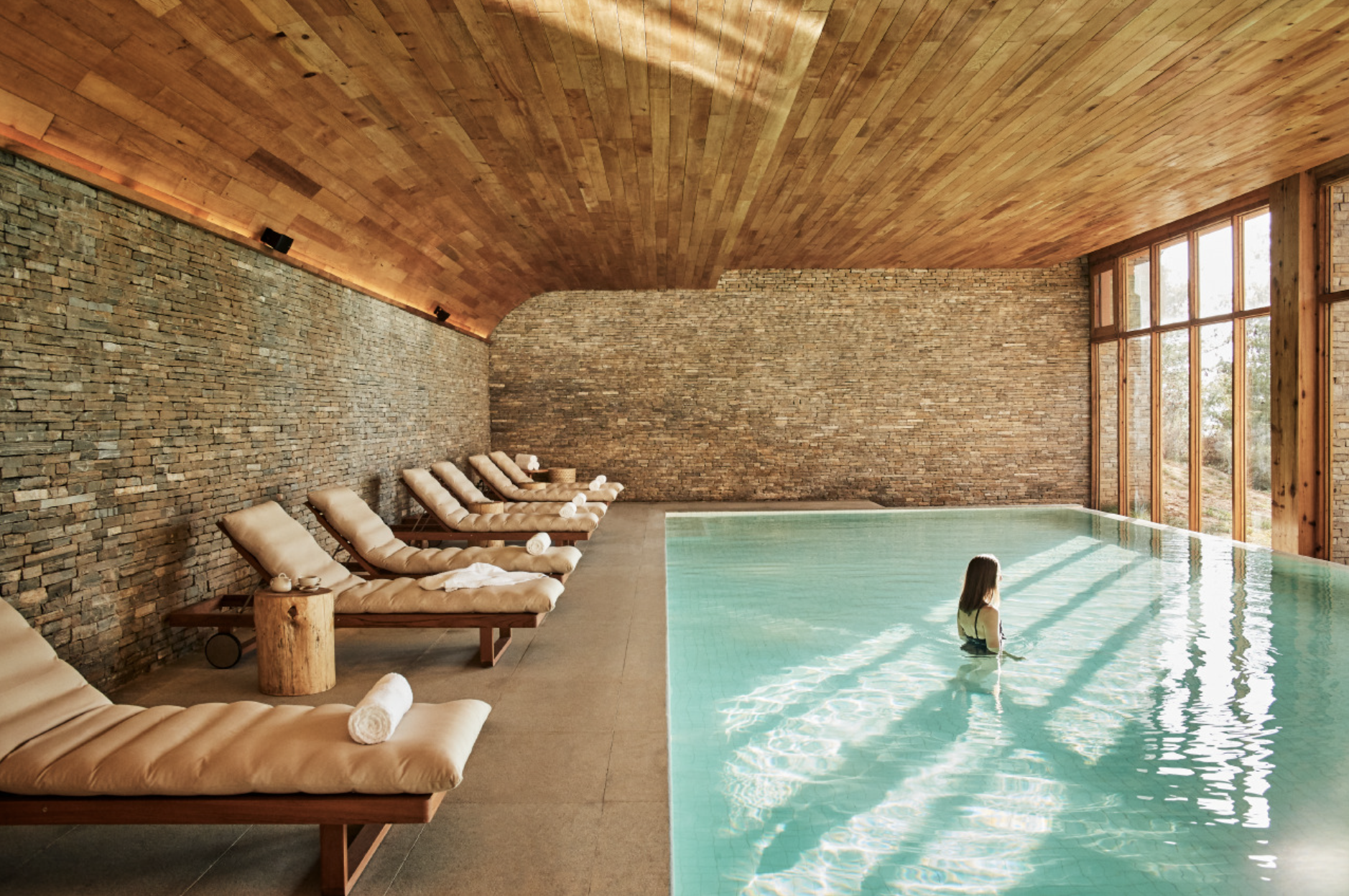
The hotel has a beautiful indoor pool in the wellness centre and can be used anytime. There is also an alternating hot and cold plunge along with a steam room as well as a wide range of treatments to heal and rejuvenate provided in pavilions below the main lobby.
The garden is a space where you can pick flowers and play archery, the national sport of Bhutan. Each evening there is a bonfire is perched right outside the lobby where guests gather after darkto chat and share stories.
Six Senses Paro archery
Several curated experiences available, including the opportunity to connect with a local monk. The monk visits the property and has a detailed conversation about life and Bhutanese astrology. The conversations promote reflection and life changes.
There are also meditation sessions that take place at the Lodge’s Prayer Pavilion, with 180-degree views of the valley, nearby monasteries and direct views to the huge Buddha Dordenma across the valley.
What’s nearby
Not too far from Six Senses Paro lies the Tiger’s Nest monastery which is challenging to climb but totally worth it. The experience is touching and humbling. Most people go to the top of the monastery to get stunning views of nature and feel connected to themselves. The Kyichu Lhakhang is a stunning monastery close to the sanctuary and is definitely worth a visit. Beyond that, Bhutan is not about doing too much at a time; it’s about taking things easy and slow, enjoying nature and connecting with yourself. It’s not a place where you go to rush. It’s a place which makes you slow down and see within. Once you see what lies in your deepest self, you are able to make changes in your life and know what you love about yourself.
Verdict
The wellness rituals, connection and nature-centric rooms and homely food make the property worth a visit. It’s like going to God’s space for a few days and coming back to yourself.
How much
Lodges start at £1,813.56 per night including breakfast, lunch and dinner.